
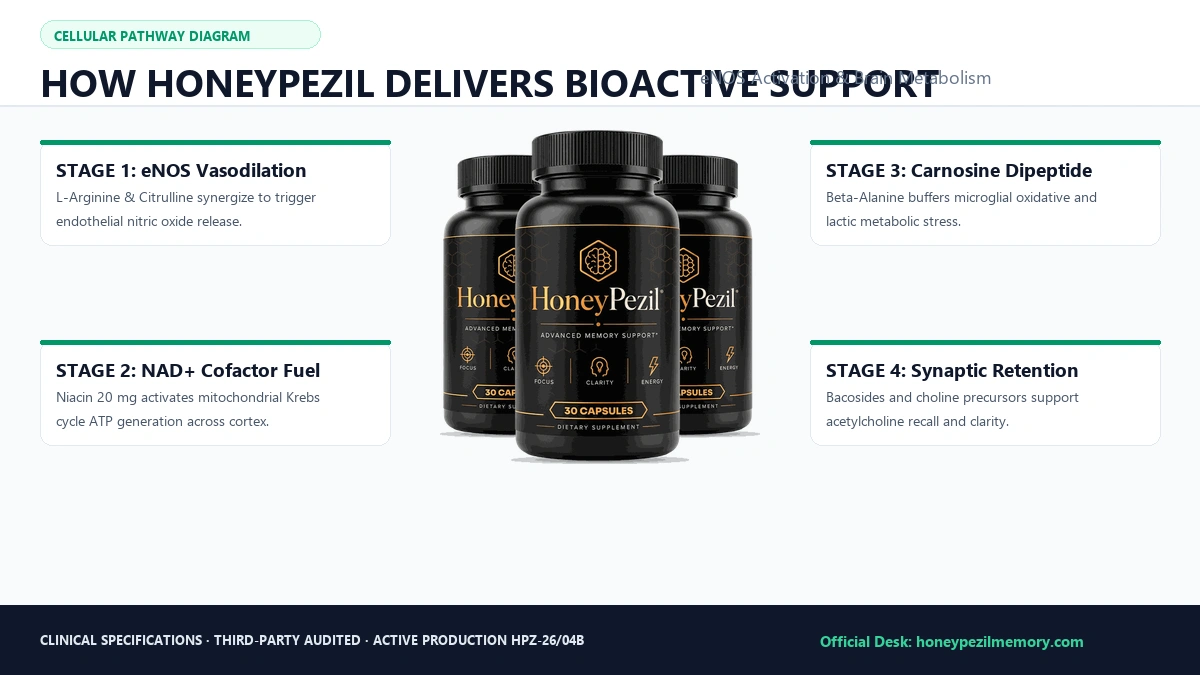
How HoneyPezil Works: The Biochemical and Cellular Science Explained
Cognitive stamina, mental clarity, and memory consolidation are not abstract phenomena; they are physical biochemical processes fundamentally governed by microvascular cerebral blood flow, oxygenation kinetics, and neuronal ATP generation. HoneyPezil operates through a targeted multi-system physiological architecture designed to nourish these exact pathways without reliance on artificial nervous system stimulants.
1. The Vascular Bottleneck: Why Brain Perfusion Dictates Cognitive Function
The human brain represents approximately 2% of total adult body weight, yet it demands over 20% of continuous cardiac resting output and 20% of systemic oxygen consumption. Unlike skeletal muscle or adipose tissue, the central nervous system possesses virtually zero capacity to store metabolic fuel. Neurons require an uninterrupted, second-by-second arterial perfusion of oxygenated hemoglobin and blood glucose. The vascular delivery system responsible for this vital supply consists of over 400 miles of microscopic capillaries whose luminal diameter is tightly regulated by vascular endothelial cells.
Beginning in the third and fourth decades of life, endothelial cells undergo progressive senescence characterized by decreased expression of endothelial nitric oxide synthase (eNOS) and elevated circulating levels of asymmetric dimethylarginine (ADMA), an endogenous competitive inhibitor of nitric oxide production. The consequences of impaired endothelial nitric oxide synthesis include:
- Microvascular Capillary Vasoconstriction: Cerebral capillary lumens narrow, increasing local resistance and reducing microcirculatory erythrocyte velocity across the prefrontal cortex and hippocampal dentate gyrus.
- Ischemic Cognitive Stalls (Brain Fog): When oxygen delivery fails to match local metabolic demand during high-intensity analytical tasks, neurons experience transient hypoxia, manifesting as mental slowness, lethargy, and word-finding blanks.
- Impaired Metabolic Waste Clearance: The brain's glymphatic fluid filtration system relies upon rhythmic arterial wall pulsations to flush out metabolic debris, neurotoxic protein fragments, and cellular waste products. Stiffened, constricted vessels impair this vital restorative clearance.
HoneyPezil directly targets this vascular bottleneck by supplying standardized amino acid precursors that fuel continuous nitric oxide biosynthesis, effectively counteracting age-related microvascular resistance.
2. The Dual-Phase Nitric Oxide Engine: L-Arginine and L-Citrulline Synergy
A frequent failing of over-the-counter nitric oxide supplements is relying exclusively on standalone L-Arginine. When ingested orally, upwards of 40% to 60% of free L-arginine is immediately metabolized by intestinal bacteria and hepatic arginase enzymes during first-pass splanchnic circulation, leaving only a fraction of the dose available to reach the systemic arterial circulation. Furthermore, plasma arginine peaks rapidly within 60 to 90 minutes and drops back to baseline, causing unstable, short-lived vasodilatory spikes.
HoneyPezil circumvents this pharmacokinetic hurdle by employing a complementary dual-phase matrix pairing two distinct arginine conjugates with two specialized citrulline salts:
L-Arginine Free Base & L-Arginine AKG 2:1
Free-base L-arginine provides immediate substrate for vascular endothelial eNOS enzymes, promoting rapid initial vasodilation. Bonded with alpha-ketoglutarate in a 2:1 molecular ratio, the AKG conjugate enhances cellular bioavailability, minimizes gastric distress, and supplies an essential intermediate directly into the mitochondrial Krebs cycle for concurrent energy metabolism.
L-Citrulline HCL & L-Citrulline Malate
L-Citrulline is not recognized or degraded by gastrointestinal or hepatic arginases. It passes intact through splanchnic circulation and travels to the renal cortex, where the enzyme argininosuccinate synthase converts it into endogenous L-arginine. This sustained recycling loop maintains elevated plasma arginine concentrations for 8 to 12 hours after morning consumption.
By uniting these four distinct compounds, HoneyPezil establishes steady, continuous endothelial nitric oxide release. Endothelial cells synthesize NO gas, which diffuses immediately into adjacent vascular smooth muscle cells. There, NO activates soluble guanylyl cyclase (sGC), catalyzing the conversion of GTP to cyclic guanosine monophosphate (cGMP). The resulting drop in intracellular calcium causes smooth muscle relaxation, widening cerebral capillaries and restoring vigorous microcirculatory perfusion.
3. Neuronal Mitochondrial Bioenergetics: The Role of Malate and Niacin
Increasing blood flow alone is insufficient if the cellular machinery inside neurons cannot effectively convert delivered oxygen and glucose into adenosine triphosphate (ATP). Neuronal signaling requires massive energetic output: maintaining the resting membrane potential across millions of synapses accounts for over 50% of total brain energy expenditure. HoneyPezil addresses cellular bioenergetics through two vital metabolic intermediaries:
1. Malic Acid (Krebs Cycle Acceleration): In L-Citrulline Malate, the malate anion participates directly in the mitochondrial tricarboxylic acid cycle. Within the mitochondrial matrix, malate dehydrogenase converts malate into oxaloacetate, directly reducing NAD+ to NADH. This NADH molecule feeds electrons into Complex I of the respiratory chain, generating the proton gradient that powers ATP synthase. By accelerating the clearance of accumulated metabolic ammonia and lactic acid, malate delays cellular fatigue and sustains executive processing stamina throughout long work afternoons.
2. Niacin-Dependent NAD+ Synthesis: Niacin (Vitamin B3) serves as the primary biochemical building block for nicotinamide adenine dinucleotide (NAD+). In aging neurons, NAD+ concentrations decline drastically, starving mitochondrial enzymes and impairing DNA repair mechanisms managed by poly(ADP-ribose) polymerase (PARP). Providing supplemental Niacin restores intracellular NAD+ pools, which in turn upregulates SIRT1 (Sirtuin 1), a crucial longevity enzyme that stimulates mitochondrial biogenesis and protects neurons from apoptosis. Additionally, Niacin stimulates dermal and microvascular blood flow, ensuring that all formula synergists reach deep cortical regions.
4. Beta-Alanine and the Intracellular Carnosine Shield
Because the brain consumes immense volumes of oxygen and contains abundant polyunsaturated fatty acids within its neuronal membranes, it is exceptionally vulnerable to lipid peroxidation and free radical damage. Reactive oxygen species (ROS) and reactive nitrogen species (RNS)—such as peroxynitrite formed when superoxide reacts with excess nitric oxide—can damage synaptic receptor proteins and induce mitochondrial DNA mutations.
To prevent oxidative damage, HoneyPezil incorporates Beta-Alanine, the rate-limiting precursor required for the synthesis of carnosine (beta-alanyl-L-histidine). While the amino acid L-histidine is abundant in the human body, beta-alanine availability strictly governs how much carnosine can be manufactured. Inside brain tissue, carnosine acts as a multifunctional cellular shield:
- Transition Metal Chelation: Carnosine binds free copper and iron ions, preventing them from catalyzing the aggressive Fenton reaction that generates destructive hydroxyl radicals.
- Anti-Glycation Protection: Carnosine reacts directly with reactive carbonyl species (malondialdehyde, methylglyoxal), neutralizing them before they can react with neuronal structural proteins to form advanced glycation end-products (AGEs).
- Intracellular Proton Buffering: During intense cognitive exertion or localized ischemia, lactic acid accumulation lowers intracellular pH. Carnosine buffers excess hydrogen ions, maintaining the optimal enzymatic pH environment required for continuous neurotransmission.
5. Cholinergic Synaptic Signaling: Bacopa and DMAE
While vascular dilation and mitochondrial ATP supply the fuel and oxygen, cognitive performance ultimately executes through synaptic neurotransmission. The primary neurotransmitter governing working memory, attention, and sensory encoding in the central nervous system is acetylcholine (ACh).
HoneyPezil supports cholinergic neurotransmission through the inclusion of DMAE Bitartrate (dimethylaminoethanol) and standardized Bacopa Monnieri extract:
DMAE Bitartrate
DMAE easily crosses the blood-brain barrier where it can incorporate into cell membranes as phosphatidylethanolamine. Within neuronal tissue, it serves as an organic precursor that assists in the biosynthesis of acetylcholine, reinforcing cholinergic tone and supporting alertness without the tachycardia or anxiety provoked by stimulants.
Standardized Bacopa Monnieri (20% Bacosides)
Bacopa monnieri has been revered in Ayurvedic herbalism for centuries as a Medhya Rasayana (brain rejuvenator). Modern clinical trials demonstrate that its active bacosides (A and B) enhance protein kinase activity within the hippocampus, stimulate synaptic dendritic branching, and upregulate endogenous antioxidant enzymes (superoxide dismutase and catalase).
6. Comparative Mechanism Matrix: Cellular Target vs. Formulation Action
| Biological Target | Underlying Cellular Challenge | HoneyPezil Active Component | Net Physiological Outcome |
|---|---|---|---|
| eNOS Enzyme Substrate | Age-related decline in nitric oxide synthesis; endothelial constriction | L-Arginine Free Base & L-Arginine AKG 2:1 | Immediate capillary vasodilation; increased oxygen perfusion |
| Plasma Arginine Pools | First-pass hepatic arginase breakdown of oral arginine | L-Citrulline HCL & Citrulline Malate | Sustained 8-12 hour nitric oxide recycling via renal conversion |
| Mitochondrial Respiration | Postprandial ATP depletion; cellular lactic acid accumulation | Malic Acid (Malate) & Niacin (Vitamin B3) | Elevated NAD+/NADH ratio; accelerated Krebs cycle ATP output |
| Intra-Neuronal Buffering | Peroxynitrite free radicals; lipid peroxidation; advanced glycation (AGEs) | Beta-Alanine | Elevated brain carnosine; metal chelation; membrane preservation |
| Synaptic Cholinergic Tone | Sluggish acetylcholine synthesis; delayed word retrieval | DMAE Bitartrate & Standardized Bacopa Monnieri | Sharper working memory recall; hippocampal dendritic branching |
Frequently Asked Questions About the Biological Mechanism
Does HoneyPezil cause a sudden blood pressure drop?
Why does the formula avoid caffeine and guarana?
How long do the nitric oxide vasodilatory effects last?
Does HoneyPezil stimulate neurogenesis or regrow brain cells?
Experience Scientifically Grounded Cognitive Support
Support your cerebral microcirculation and brain energy pathways with verified, climate-controlled stock from certified production Lot HPZ-26/04B.
Claim Factory Stock • From $49 / Bottle →